Spark Tester for Cables

Puretronics introduces a complete range of spark testers for the cable extrusion process to check the insulation quality of the wire being produced.

Puretronics introduces complete range of Spark Tester for Cable Extrusion Process to check the insulation quality of the wire being produced. For the testing the dry cable runs through the electrode thereby the cable being exposed to the Voltage set by the user. The device based on its senstivity and voltage detects the faults and puntures in the insulation of the cable.

Based on the application Mains Frequency AC Spark Tester (50-60Hz), High Frequency AC Spark Tester (2.5KHz-3.5KHz), DC Spark Tester are being used.

Its ease to operation, setup and integration with the system, makes it simplier for any operate the use the device efficiently and maintain it properly at the same time.

  • Features
  • Technical Specification
  • Accessory
  • Application - Insulation Testing
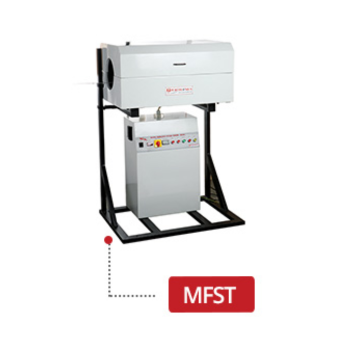
MFST (Mains Frequency Spark Tester)
  • Confirms to Major Standards
  • All digit digital display readout
  • 2 Change Over relay output for different interlocks
  • Fault vs Length Graph and Data Logging (Optional)
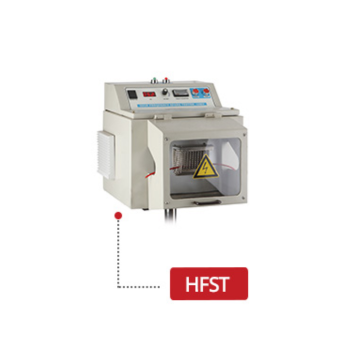
HFST (High Frequency Spark Tester)
  • Confirms to Major Standards
  • All digit digital display readout
  • 2 Change Over relay output for different interlocks
  • Fault vs Length Graph and Data Logging (Optional)
  • Stand with adjustable height based on the model
  • MOSFET based Sine wave low power circuit
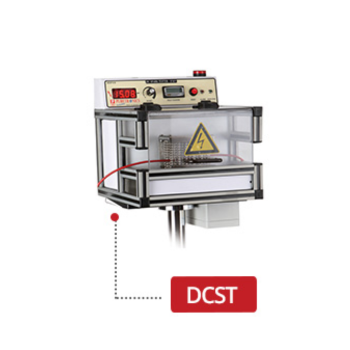
DCST
  • Confirms to Major Standards fault detection at very high speed
  • Require very less space to install
  • Robust design
  • Absolutely fatal free to human
  • Easy Pin Hole Detection
  • All digit digital display readout
  • 2 Change Over relay output for different interlocks
  • Fault vs Length Graph and Data Logging (Optional)
  • Stand with adjustable height based on the model
Model MFST-15/25/40kv HFST-10/15kv DC-15/25kv
Voltage Range 1.5 to 15kv/25kv/40kv 1.5 to 15kv 1.5 to 15/25kv
Test Frequency 50/60hz (Same as supply Frequency) 2.5 to 3.5khz
Sine wave A.C RMS
Direct Current
Wire Size 0.5 T0 40mm 0.D
(60mm on demand)
0.5 to 15mm 0.D 0.5 to 15mm 0.D
(30mm on demand)
Electrode Bead chain housing of 350mm long Bead chain housing of 70mm long Bead chain housing of 70mm long
Max Wire Speed 200mts/min 2500mts/min 2500mts/min
H.V Meter Digital LED Digital LED Digital LED
Sensitivity Selectable position switch/Adjustable knob As per standard As per standard
Fault Counter 6 digit LCD Self Powered 6 digit LCD Self Powered 6 digit LCD Self Powered
Power Supply 230v AC 50/60 Hz, 1KVA 230v AC 50/60Hz, 0.5KVA 165 —200VAC, 0.5kVA
Interlocking By potential free change over By potential free change over By potential free change over
Safety Door interlocking Door interlocking Door interlocking
Adjustable wire Running height 950mm to 1100mm from ground level 900mm to 1100mm from ground level(With Stand Acc.) 900mm to 1100mm from ground level(With Stand Acc.)
Dimension in MM(15kv) 820W x 1160H x 460D 450W x 336H x 405D 282W x 252H x 270D
Approximate Weight(15kv) 80 Kg 20.4 Kg 7.94 kg
STAND-DCST The stand is used for DCST-15KV/20KV to keep it steady during the production. The adjustable height of the stand makes it easier in case of interfacing it with different machine and different application.
STAND-HFST The stand is used for HFST-10KV to keep it steady during the production. The adjustable height of the stand makes it easier in case of interfacing it with different machine and different application.
  • Online Extrusion Insulation Testing.
  • Online Rewinding & Testing Machine.
  • Online Coiling Machine.
  • Inspection Machine.
  • For Power Cable, Control Cable, Telephone Cable, LAN Cable, RF Cable, Automotive Wire, Building Wire.
Frequently Asked Questions

A spark tester for cables is widely used in cable manufacturing to detect insulation faults in real time. Below are some common questions related to spark testing, working principles, and applications.

A spark tester for cables is a high-voltage testing device used to detect insulation defects during cable manufacturing. It works by creating an electrical field around the cable, where any flaw in insulation results in a spark discharge that is immediately detected.
A spark tester works by passing the insulated cable through a high-voltage electrode. If the insulation is intact, no reaction occurs. If there is a defect such as a pinhole or crack, the electrical field breaks down and generates a spark, which is detected and recorded in real time.
The voltage used in spark testing depends on the cable diameter, insulation thickness, and material type. Typically, spark testers operate in the range of 1.5 kV to 40 kV for different cable applications including LT and HT cables.
There are three main types of spark testers for cables:
  • AC Spark Tester (Acute Spark Tester) - used for detecting micro defects in wires
  • DC Spark Tester - suitable for multi-core cables and stable testing
  • High Voltage / Live Spark Tester - used for LT and HT cable testing
Each type is selected based on application and production requirements.
Spark testing is important because it ensures insulation integrity, prevents electrical failures, reduces material wastage, and improves overall product quality. It also enhances safety by detecting defects before cables are installed in real-world applications.
Yes, spark testers are highly sensitive and can detect microscopic defects such as pinholes, cracks, and weak insulation points that are not visible through manual inspection methods.
AC spark testers generate a corona effect and are ideal for detecting very fine defects, while DC spark testers do not produce heat and are better suited for testing multi-core cables and larger insulation structures.
Spark testers are also used in:
  • Wire manufacturing
  • Corrugated pipes
  • Medical tubing
  • Industrial insulation products
They are useful wherever surface integrity and insulation quality are critical.
No, when used with the correct voltage settings as per industry standards, spark testing does not damage cable insulation. Proper calibration ensures accurate defect detection without affecting product quality.
Using a spark tester for cables provides multiple benefits:
  • Real-time defect detection
  • Improved product quality
  • Reduced rejection rates
  • Enhanced safety
  • Better process control through digital monitoring
They are useful wherever surface integrity and insulation quality are critical.
Request A Call Back